
When Search Ends, What Begins?
The future of the internet and the transition to agentics

We used to figure things out.
For most of the internet’s history, that’s what it was for. It was a space where we figured things out. You'd go searching if you had a problem or even just a feeling that something wasn’t quite working.
Tap-tap-tap.
You’d type a question into the search bar, scroll through a few pages, and you were sitting with a trail of open tabs before you knew it.
Still, it was never really about finding the perfect answer. Most of the time, you were just looking for something that made enough sense to move forward with, whether that was a starting point, a clue, or just a glimmer of possibility and over time, we got better at it.
We wrapped our questions in data, called them hypotheses, tested ideas with dashboards and A/B tools. And while the answers weren’t always right, they were ours. Shaped by context, effort, and reflection.
But the thing is, search was never truly neutral. We learned to ask questions in ways the system could understand. We typed what we thought Google could “read”, not always what we actually meant. When we searched for “best project management tool”, we landed on listicles written for affiliate clicks. When we wanted to understand SaaS pricing, we read VC blogs built to promote their frameworks. Even something like “does this supplement work” brought us to SEO-optimised sites chasing conversions, not nuance.
And yet, we made it work. We stitched together insight from what we had. Built mental models. Took notes. Changed our minds.
But now, with generative AI and agentic tools, we no longer have to wander. You describe the problem, and the system gives you the plan. You have a conversation, and the answer arrives. Clean, confident, complete.
The process feels faster. It feels more useful. But if the path of searching disappears, so does the process of figuring things out. And if that process was how we made sense of things… I can’t help but wonder:
What happens to the internet when we no longer have to search?
The Internet Is Becoming Infrastructure
Agentic systems mark a shift not just in how we use the internet but in what the internet is.
The early web was built to be explored. Pages linked to other pages and this where you searched, browsed, wandered. This process of “discovery” was part of the experience.
But today, more of the internet is being designed to serve machines and not people. Websites are stripped down to raw data, and APIs replace front-ends. Now, if brands are smart enough, content is being produced for AI retrieval.
This means that in many cases, humans are no longer the intended users at all.
Increasingly, the internet operates in the background for fetching, processing, and delivering. You prompt, and the result is returned. The steps in between are invisible. That invisibility changes how information is created and maintained. When systems retrieve knowledge without attribution or interaction, it becomes harder to preserve the public context around it. Pages decay. Links break. Fewer sites are built. Less content is written for people to engage with directly. Therefore, the structure of the internet starts to resemble infrastructure. It works, but you don’t see how. And eventually, you stop noticing what’s missing.
This shift is not hypothetical. It’s already underway. But it hasn’t been evenly distributed, and it’s not fully mature. The tools are improving, but the systems are still brittle. Mistakes happen. Preferences are misunderstood. Source material disappears. So this isn’t just a new interface. It’s a redefinition of the web itself.
The internet is becoming a service layer and is becoming something that operates on our behalf.
Staying Visible in an Invisible Internet
If the internet is shifting from something we navigate to something that acts on our behalf, the way we show up inside it has to shift too.
Here are four ways to stay present and how to build with intention.
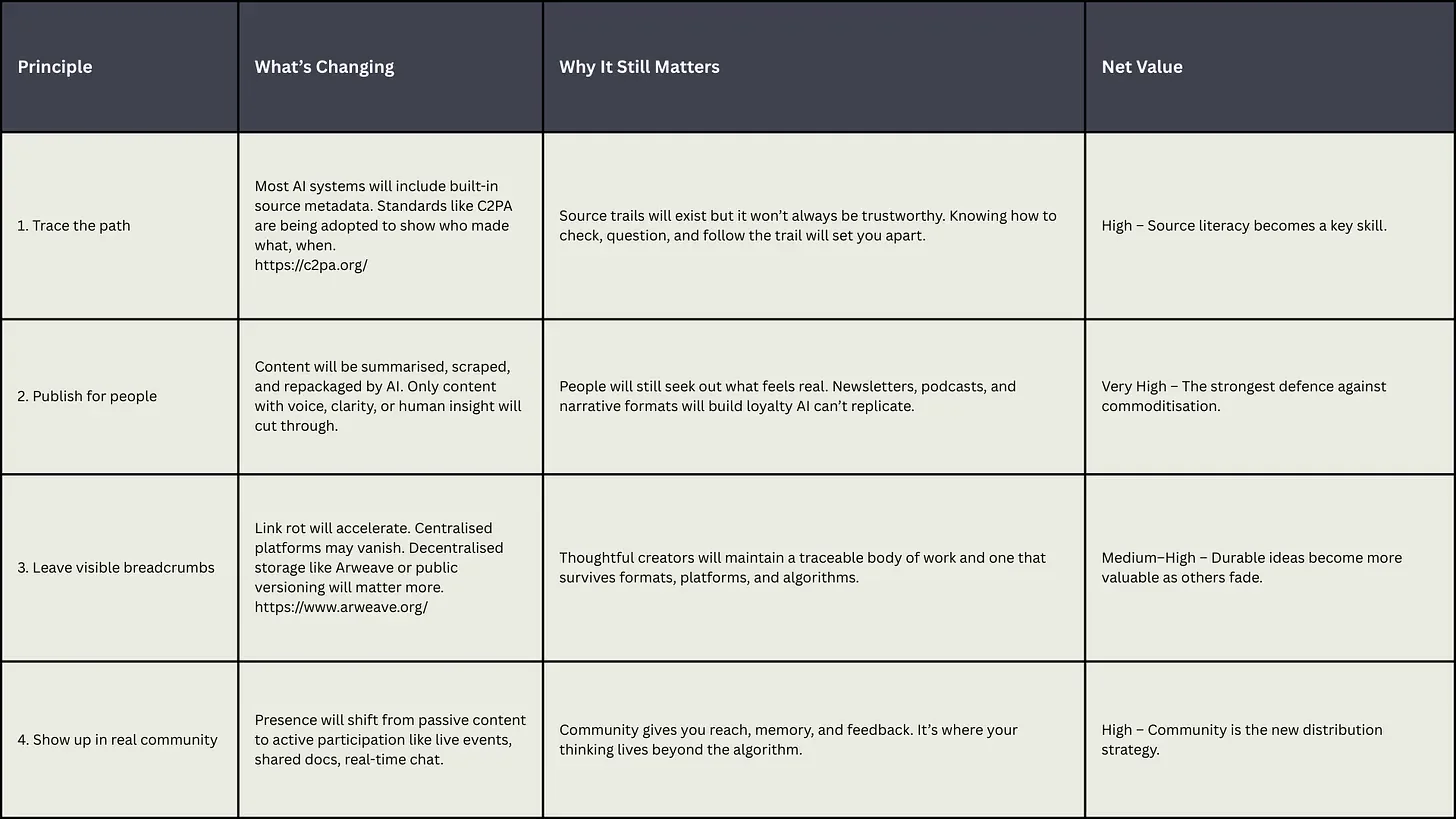
A Prompt For Presence
Now ask, what part of your digital presence today would still exist if no one searched for it?
Would your work still be visible? Would your thinking be traceable? Would your voice be remembered?
Pick one thing this week, an idea, a thread or a resource and make it findable on your terms and make it for memory and not for reach…yours, and maybe someone or something else’s.
The web we grew up with was built around exploration and the one we’re heading into is being shaped by systems that act on our behalf. That doesn’t mean we lose agency. But it does mean we need to show up differently.
Be intentional with your inputs. Be visible in the spaces that still invite conversation. And don’t underestimate the power of publishing for humans.
All the Zest 🍋
Cien
P.S. If this made you feel something, forward it to someone who might need a reminder: we’re still here, still dreaming, and now, maybe, a little closer to touching it.
Listen in:[Subscribe to the Podcast]