
The $15 Trillion Club You’re Not In
The richest technology in history has the smallest door

$15 trillion. That is the projected contribution of AI to global GDP by 2030. It gets thrown into conference decks and keynote openers, usually followed by something about how transformative this moment is and how everyone needs to get on board.
The obvious question is, “but for whom?”
I came across a stat recently that stopped me mid-scroll. Only 0.04% of people are actively coding with AI, a number so small it exposes just how narrow the door actually is into a $15 trillion wealth-generating machine.
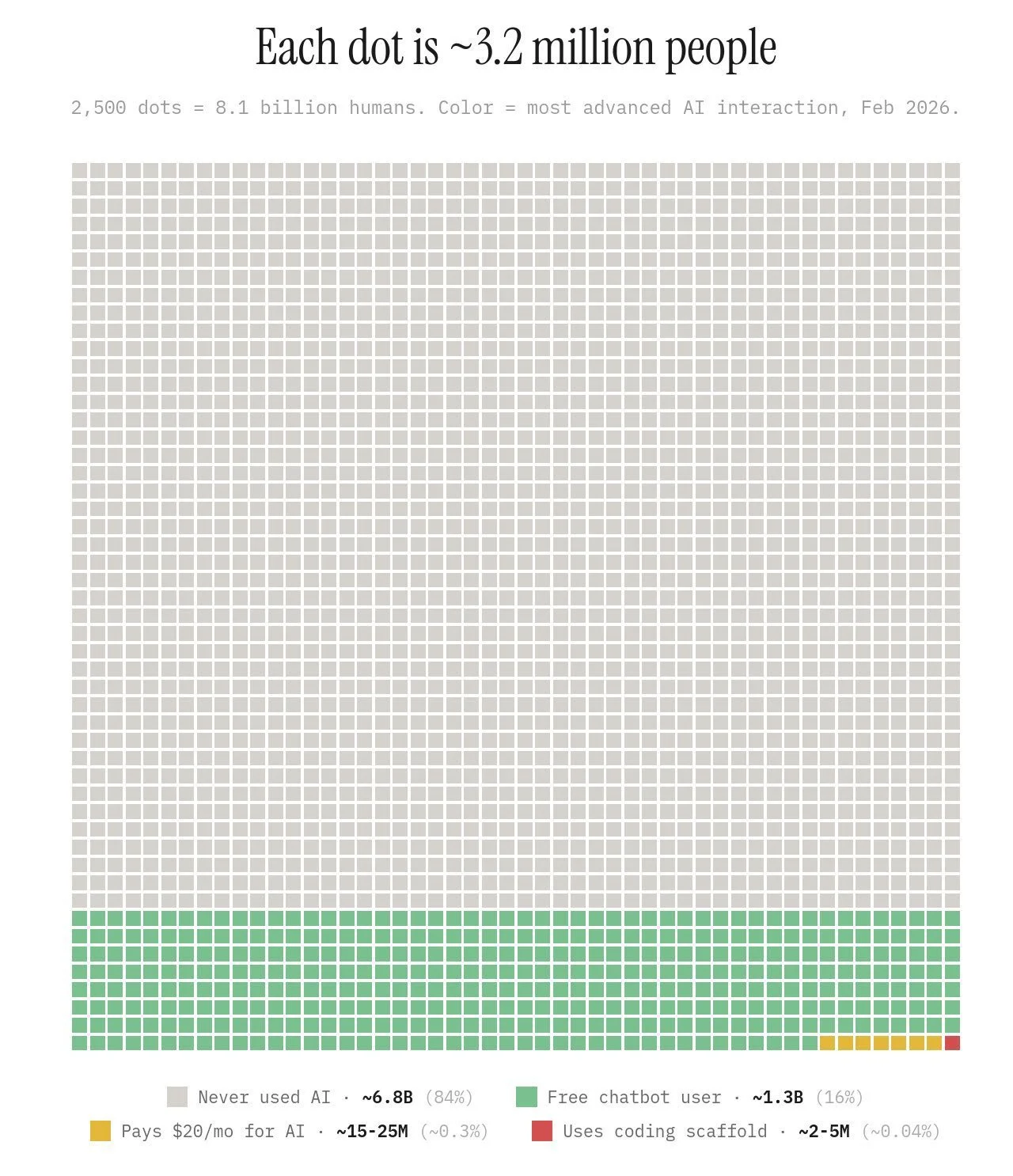
From where I sit, the conversation about who benefits from AI is still almost entirely focused on the developers, researchers, and founders shipping models and deploying infrastructure. Somewhere along the way, we started treating our participation in AI as everyone’s participation in AI. We looked at the activity at the frontier and called it a revolution, while 99.96% of people watched from a window.
The $15 trillion will land somewhere. It will compound in the hands of companies that deployed early, platforms that cornered distribution, and individuals who learned to use the tools before the tools became table stakes.
Historiocally, we have seen tech revolutions do not distribute wealth evenly. They accelerate existing advantages unless someone actively intervenes.
Most people are not waiting to code. They are waiting to understand whether any of this is actually for them. And right now, it is barely designed for them at all.
I have been thinking about this through the lens of the three types of people I see in the AI economy right now.
The Builders, the Operators, and the Observers.
The 0.04%.
First the builders. I am one of them, which is why I can tell you honestly that being a Builder does not automatically mean you are winning. The funding concentrates at the top. The distribution goes to whoever already had it. The models getting all the attention were built by teams with hundreds of millions behind them. Being a Builder is not a guaranteed seat at the table. It is just a different kind of uncertainty.
The Operators are the most underrated group in the room. They are not building AI, but they are using it with enough intention and consistency that the gap between them and everyone else is widening in ways that do not yet show up anywhere visible. They will, eventually.
The Observers are waiting. Waiting to feel ready, waiting for the right moment, waiting for someone to tell them it is safe. I understand this more than I used to. The tools move fast, the noise is deafening, and it is genuinely hard to know what to pay attention to. But readiness tends to arrive after the window has already moved, and that is the part that worries me.
This keeps me up at night. The pace at which someone else will build a good enough approximation of an observer’s expertise is faster than most people realise. And most clients will not notice the difference until it is already too late to matter. The Operator and the builder who encodes their knowledge into AI multiplies themselves. The one who waits gets replaced by a version of themselves they had no hand in building.
If you have been looking for a way in that does not require a technical background, the tool you pick matters less than learning to use any of them with intention. Here are three places to start, depending on where you are.
If you are brand new, the MIT Sloan prompting guide is written for you. Find it at mitsloanedtech.mit.edu/ai/basics/effective-prompts
If you want to go further and understand how prompting works inside AI systems, the LaunchLemonade system prompting guide walks you through building your own AI assistant from scratch without writing a single line of code. Find it at launchlemonade.app/blog/a-beginners-guide-into-system-prompting
And if you are technical and want to go deep, NVIDIA’s prompting and LLM certification path is worth exploring. Find it at nvidia.com/en-us/learn/certification/generative-ai-llm-associate
Who are you? A Builder? Operator or Observer?
Be honest with yourself. Then decide if that is where you want to stay.
The $15 trillion is not going to the people who understand AI best. It is not even going to all the people building it. It is going to the people who act on what they already know, using AI to carry it further than they could carry it alone.
I build the tools because I believe the door should be wider. But I have also watched enough of the inside to know that a wider door is not a guarantee of anything. What matters is what you do once you are through it.
All the Zest 🍋
Cien