
Stop Chasing Magic
And Start Building Systems

You don’t need another AI assistant who almost finishes the job. You need one that knows what it’s doing, grabs the right info, adapts when things change, and hands you something useful before lunch.
But here’s the problem:
Most people expect too much from one agent, and too soon.
The Trust Breakdown
We want AI to be the butler, the strategist, and the executive assistant. But what we get is often more like a clumsy intern with memory issues.
According to Google, 70% of people in the UK use AI personally, but less than half trust it at work. And when AI fails, trust doesn’t just dip, it vanishes.
Klarna famously replaced 700 employees with AI in 2022… then very recently admitted quality had tanked and started rehiring. Oops.
So what is the lesson here? It's not just about building agents but rather, about building the right kind, and knowing what to expect.
So, What Is an AI Agent Really?
Let’s clear this up.
An agent isn’t defined by fancy output. It’s defined by behaviour.
To be agentic, it must:
Understand a goal
Decide how to complete it
Use tools or memory as needed
Carry out steps toward the goal
(Ideally) improve over time
Yes, it’s still an agent even if the output is “just a chat reply” as long as it decides how to respond, pulls info, reasons, and works within a flow.
Yes, it’s still an agent if you, the human, make the final call.
You might review, approve, or send the final output, which is what I call responsible oversight.
Agent ≠ automation with no humans.
Agent = intelligent system that acts on your behalf within limits.
Where Most Agents Go Wrong
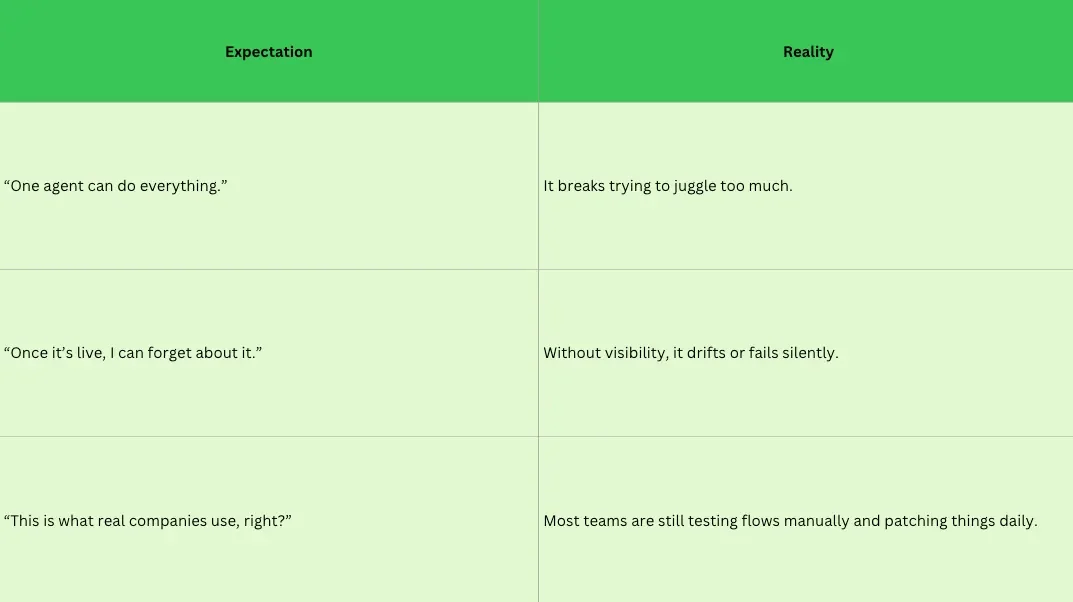
So if your “agent” just answers questions with no logic, no flow, and no memory? It’s not an agent. It’s a chatbot with a degree in improv.
How LaunchLemonade Builds Real Agents
LaunchLemonade helps you build practical, agentic systems, even if you’re non-technical, impatient, or allergic to JSON.
✅ Describe it in plain English
Our system prompt assistant turns natural language into structured instructions. You won’t need prompt engineering PhD to be able to do this.
✅ One agent, many models
Route tasks to the model best suited for the job, Claude 3.7 for reasoning, Gemini 2.5 for speed, Llama 4 for tone, GPT o3 for research. Up to 15 models in one workflow.
✅ Smarts that remember
Upload PDFs, connect Google Drive, plug in Notion, or scrape websites. We convert your content into a searchable long-term memory. The agent decides what to pull, and when.
✅ Agents that coordinate
You can configure multi-step workflows where each task is handed off to a different model, or even a
different agent. That’s agent-to-agent collaboration, not just chat.
✅ Transparent by default
We log every conversation so you can review what your agent said, how it responded, and what was asked. You won’t see every internal step (yet), but you will have a clear record of how your agent handled each interaction, great for spotting drift, improving instructions, and maintaining quality over time.
Full trace view (including decision steps and data calls) is on our roadmap.
Try This: Build a Smarter Agent This Week
Go to sip.launchlemonade.app
Click “New Lemonade” and choose “Chat Lemonade” and choose an LLM or Auto-route
Describe what you want your Lemonade to do, in your own words
Add knowledge: upload PDFs, connect Google Drive or Notion, or scrape the web
Run it, test it, refine it
Then take it further:
6. Link multiple Lemonades into a Flow
7. Assign different models to different steps
8. Let one Lemonade hand off to another, just like a smart team
9. Keep reviewing your chat logs to improve performance
10. Optional: configure your Agent to act without you (with boundaries you control)
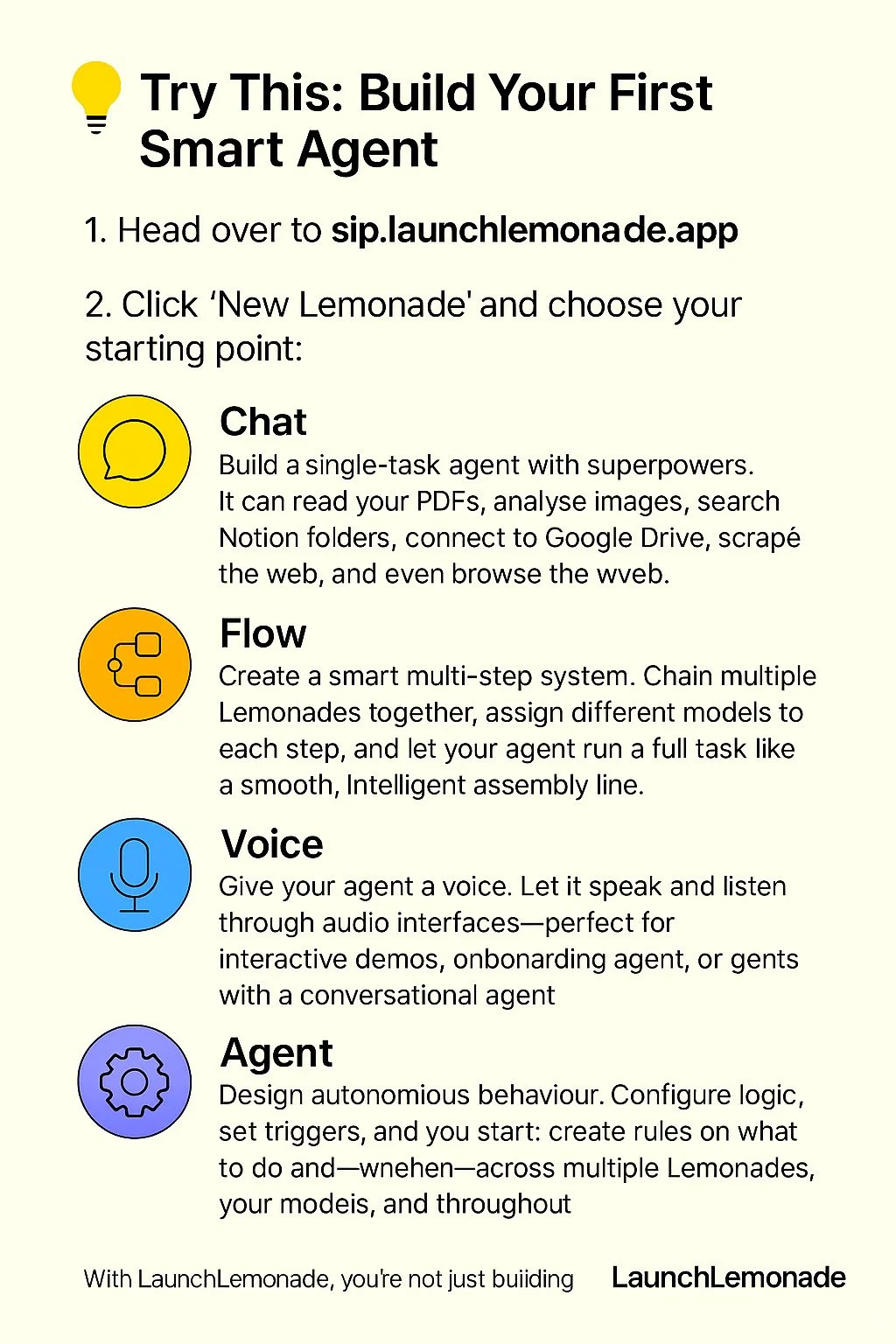
You're not just creating a chatbot now, you're creating specialised, intelligent agents, each designed to think, decide, and deliver results.
Start small. Test fast. Then scale with structure.
Lots of Lemons 🍋,
Cien