
ROI or Bust
How to Actually Measure AI’s Value
You know what’s better than a shiny new AI implementation? A shiny new AI feature that actually pays for itself.
Most teams are burning money on “prompt workshops,” as if perfect syntax is the end game. Others are stuck forever cleaning data sets, stockpiling information, but never unleashing it to drive real results.
If you’re not asking why you’re building with AI, or tracking what it’s actually delivering, then, you’re just perfecting the art of being busy.
From Digital Departments to AI-First Teams
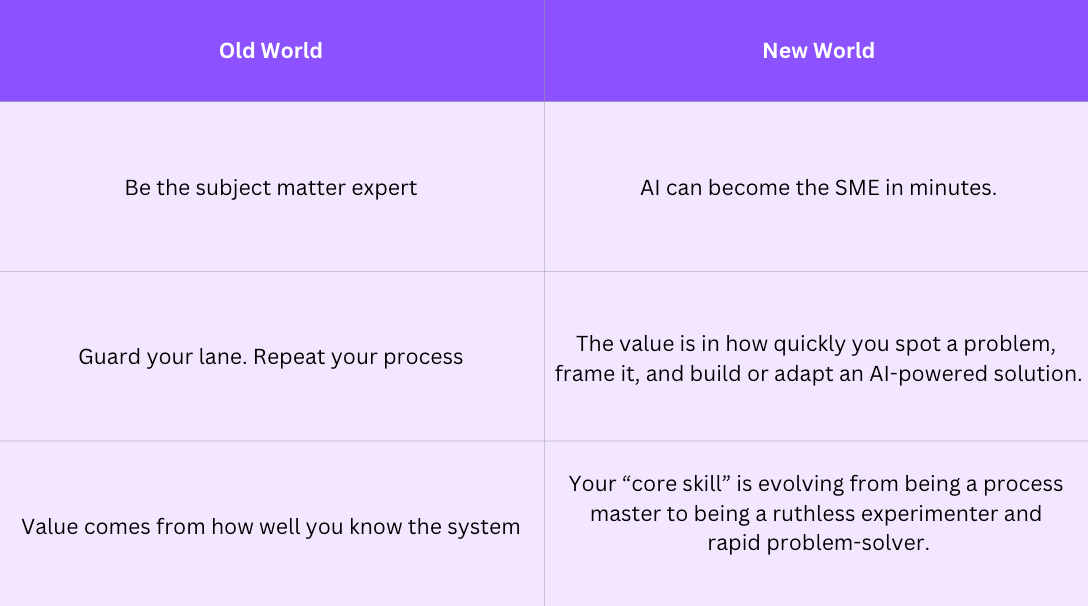
In the “old” world, every company had its digital transformation department, which is often a special team or a grand project plan, measured in milestones.
That’s not how it works anymore.
Today, AI IS the department. Or more provocatively, everyone can be their own AI department.
If your expertise is based on memorising process or hoarding information, AI is coming for your job description.
But if you can leverage AI to solve new problems, connect dots, and create value beyond what the system can do alone, you become indispensable.
“A Note For Business Leaders:
Are you teaching your team to use AI, or are you building a culture where everyone is empowered to redefine their role, use AI as a partner, and deliver outcomes that were impossible (or at least, impossibly slow) before?”
The Ridiculously Practical AI ROI Playbook
Forget those “AI impact dashboards” nobody checks and the endless cycle of PowerPoints with charts nobody trusts.
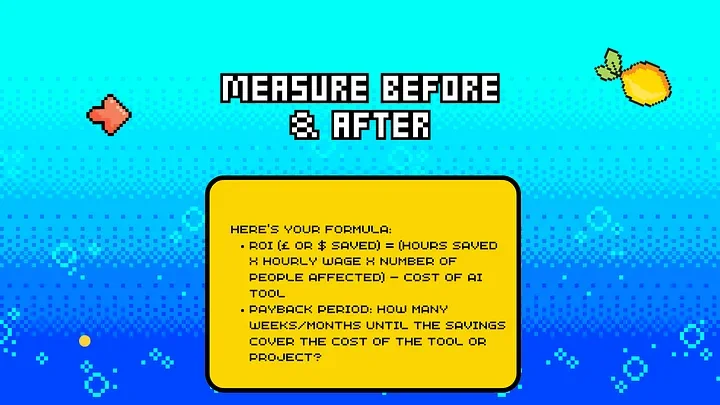
Here’s the real way to figure out if your AI project is worth its digital weight in lemons:
🍋 Real Example:
Before:
Sales admin spent 20 hours/month on lead follow-up. At $50/hr, that’s $1,000/month.
After AI:
2 hours/month. Savings: 18 hours x $50 = $900/month.
AI tool costs $25/month.
Net gain: $875/month.
Time to payback: Instantly juicy!
The Super Assistant
Want to know how I get sharper, faster ROI on my own work?
I built a Super Assistant where no single AI gets to coast, and every output gets a second opinion (or two) before it goes out the door.
Get the system prompt for your Super Assistant here and start getting different LLMs to collaborate ane review each other’s output.
Why it’s zesty:
No more single-model tunnel vision.
Outputs get tougher, more accountable, and more robust—every time.
Anyone on your team can do this—no technical expertise required, just better thinking by design.
Mini-Challenge:
Pick your next business challenge.
Draft the answer with one AI model.
Then, before you sign off, deliberately ask a different model to review, question, or suggest improvements.
Let me know how it goes and until next week!
Lots of Lemons 🍋,
Cien